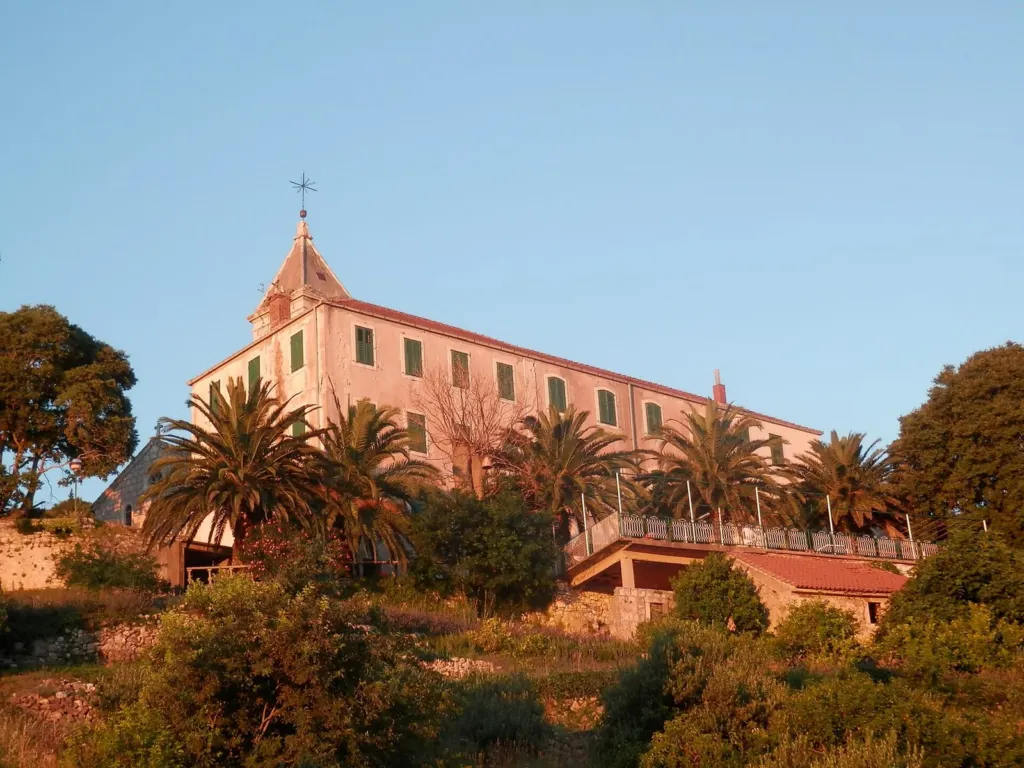
More than 1,400 years ago, 16 Latin verses were carved into a rock on the beach in Porat in honour of a spring. Above it stands the Franciscan monastery of the Holy Cross, founded in 1612. The Ottomans burned it, the French occupied it and the 1962 earthquake badly damaged it. Porat is about a twenty-minute walk along the sea from Mala Duba.
From the promenade
What you see when you reach Porat
Above the pebble beach in Porat rises the monastery: the church and three monastery wings, two of which have four storeys each. The bell tower on the south side of the church ends in a stone pyramid, and an old defensive tower stands on the corner facing the sea. The inscription is down on the beach itself, in the large rock below the monastery.
Through time
Ten dates, from hillfort to the present day
- from the 8th c. BC People live on the Matijaševica hillfort near Blato, a hilltop settlement enclosed by a dry-stone wall.
- Roman times A Roman country villa stood at Pločica in Mala Duba; its remains were destroyed in the 1960s. The urn burial beside it dates from the 1st or 2nd century.
- 4th–6th c. In a rock on the beach in Porat, 16 Latin verses are carved in honour of a spring.
- 1254–1264 Živogošće is first mentioned in written sources, together with Strnj.
- 1612 The Franciscans establish the monastery beside the spring; the first church is completed in 1620.
- 1647 The Ottomans burn the village and the monastery. The friars had already taken refuge across the sea in Sućuraj.
- 1766 The present church of the Holy Cross is built.
- 1907 Francesco Ravalico paints the vault of the church.
- 1962 An earthquake badly damages the monastery; it is restored in the 1970s.
- 1965 and 1971 The monastery, and then the inscription, become protected cultural heritage.
Late Antiquity · 4th–6th century
A poem carved into the living rock
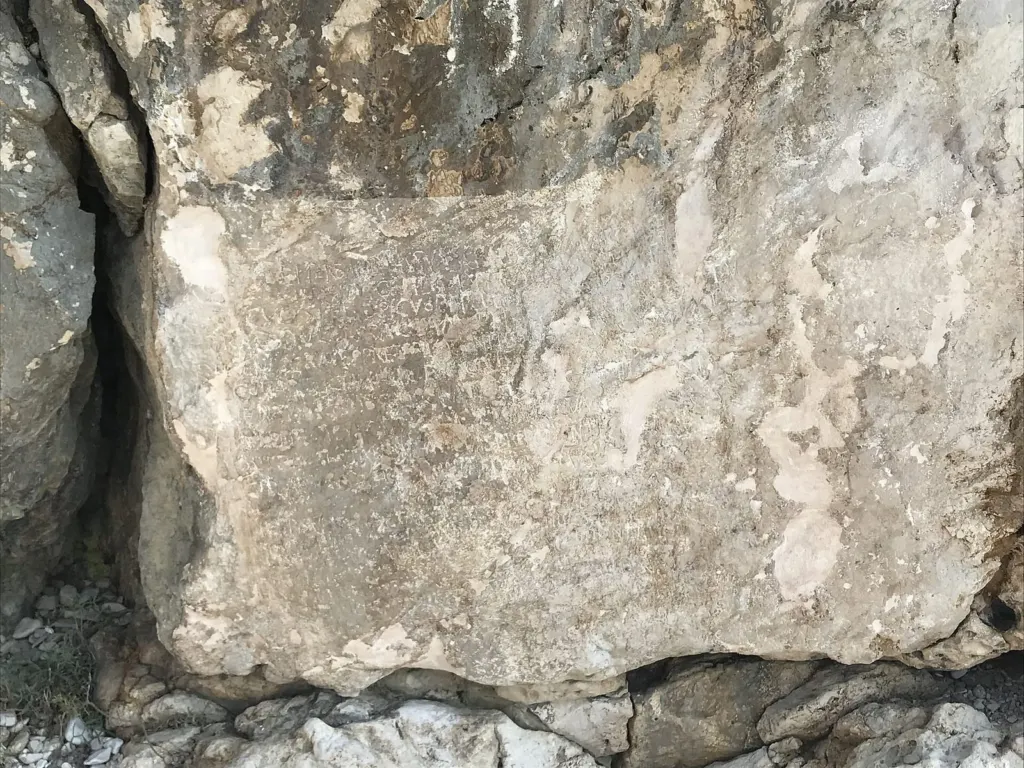
On the beach below the monastery in Porat rises a large rock. Between the 4th and 6th centuries, 16 Latin verses were carved into it – not on a separate slab, but directly into the living rock. This is Late Antiquity, the last centuries of Roman rule on this coast. The verses praise the Pokrivenica spring, which once rose here from the rock and, after a short course, flowed into the sea. Today water no longer flows from the spring by that rock.
The poem has two voices. In the first ten lines Licinianus, the master of the estate, speaks. He greets the nymph, in Roman religion the divinity of a spring, and thanks her for honouring his estate with cold, healing water. The last six lines probably belong to his wife Pelagia. She asks which sage could fathom the secret of the spring, and ends by saying that with this epigram, a short poem written for an inscription, she honours the springs.
“You are born of the crag, O spring, and you will die in the sea.”
From the inscription, our translation
Small crosses, verses and a legend about an emperor
The verses are written in elegiac couplets, pairs of lines in which a longer line is followed by a shorter one, as Roman poets wrote. Six small crosses are cut at the beginning, in the middle and at the end of the inscription. Because of them, scholars date the inscription to a time when Christianity had already reached this area, even though the poem greets a nymph.
The archaeologist Duje Rendić-Miočević translated the verses and included them in a collection of ancient poems carved in stone. Most of that collection consists of funerary inscriptions, and Tonko Maroević writes in his review that this poem stands out from all the others: it is carved into the living rock and speaks of gratitude to a spring and of a married couple. Some local writers linked Licinianus with the Roman emperor Licinius of the 4th century. That is only a legend, which the Register of Cultural Goods also mentions; in the verses he simply calls himself the master of the estate.
The verses in the original and in our translation
The inscription in the rock
Latin original (line by line; square brackets mark damaged parts restored by scholars):
Litorea praessus scruposae margine r[up]isinriguus gelido defluit amne latex,cuius perspicuo per levi[a s]ax[a m]e[a]tupraedulcis salsam perl[uit unda Thet]yn.Indigenis gratus, preterlabentibu[s almus],i[n]cola delicias, advena laudat [opes].Sa[l]ve, Nymfa, meos dignata inv[iser]e finiset celebrem cunctis conciliare locum.Nostra salutifero tu mactas pr(a)ed[ia fo]nte;Licinianus ego carmine te dom[i]nus.Diversum sortita capis finemq[ue caputq]ue:Nymfa, caput cautes, term[inus unda] tibi est.Quis queat arcanum sap[iens pernosce]re fontis?Nasceris e scopulis, fo[ns, moriture freti]s.Hoc Pelagia suos fontes epig[r]ammate donat,magne, tui pignus, Lic[inia]ne, [tori].
Our free translation:
Hemmed in at the shoreline edge of a rugged crag,the water that soaks the land runs off in a cold stream;in a clear course over smooth stonesits sweetest wave washes the salt sea.Dear to the locals, kindly to travellers passing by:the resident praises its charms, the newcomer its abundance.Hail, Nymph, who have deigned to visit my boundsand to make this place renowned before all.You honour our estates with a healing spring,and I, Licinianus, the master, honour you with a poem.Fate has given you a beginning and an end of wholly different nature:Nymph, your source is the rock, your end the wave.What sage could fathom the secret of the spring?You are born of the crag, O spring, and you will die in the sea.With this epigram Pelagia presents her springs –a pledge, great Licinianus, of your marriage.
Latin text after the Epigraphic Database Heidelberg (HD053666); cf. CIL III 1894 and CLE 1531. This is our own free translation, not a scholarly one.
From 1612
The monastery and church of the Holy Cross
The Franciscans built the monastery at the beginning of the 17th century, beside the same spring to which the inscription on the beach is dedicated. According to an old monastery book, it was founded in 1612; the name of the Holy Cross is first mentioned in 1614, and the first church was completed in 1620.
Franciscan tradition also remembers why they chose this spot. In 1563 several friars fled from a monastery near Mostar and settled in Drašnice, by the church of St George. There they suffered from the bura wind and its posolica, the fine sea spray that the wind carries onto the shore, so they found shelter in Živogošće, below the hill of Suzina.
A monastery that was a fortress
The coast was then under Ottoman rule, so the monastery was built as a small fortress and a refuge for the friars and the people. Walled-up loopholes, narrow openings for firing through, have been found in the walls. Tradition says the doors were low and narrow so that the Turks could not ride in on horseback. The sultan permitted the building with a firman, an imperial permit, in 1623.
In the War of Candia, the war between Venice and the Ottomans for Crete, the locals sided with Venice in 1646. The Ottomans took revenge in 1647 and set fire to the houses in Živogošće and to the monastery. The friars had already taken refuge across the sea in Sućuraj on Hvar, and on their return they found it in ashes. They rebuilt the monastery with the help of the Šoić family from Mostar and a new firman from Sultan Mehmed IV, issued in 1672.
Outside: two dates above the door
The present church was built in 1766. Above the entrance a Latin inscription is carved with the dates MDCXX and MDCCLXVI: the church of the Holy Cross was first built in 1620, and in 1766 a finer one was raised from its foundations. Building was begun by Fra Petar Karapandža, who had entered the order in this monastery, led the whole Franciscan province from 1742 to 1745 and received books and paintings as a gift from Empress Maria Theresa. He was buried in the new church in 1761, before it was completed.
The bell tower on the south side of the church is older than the church itself: an inscription on its west wall, about ten metres above the ground, bears the year 1733. The tower ends in a stone pyramid. The church and three monastery wings enclose the cloister, an inner courtyard surrounded by a corridor. The south and east wings each have four storeys, and at the south-east corner, facing the sea, stands a defensive tower built between 1647 and 1730.
Inside: Emperor Constantine on the vault
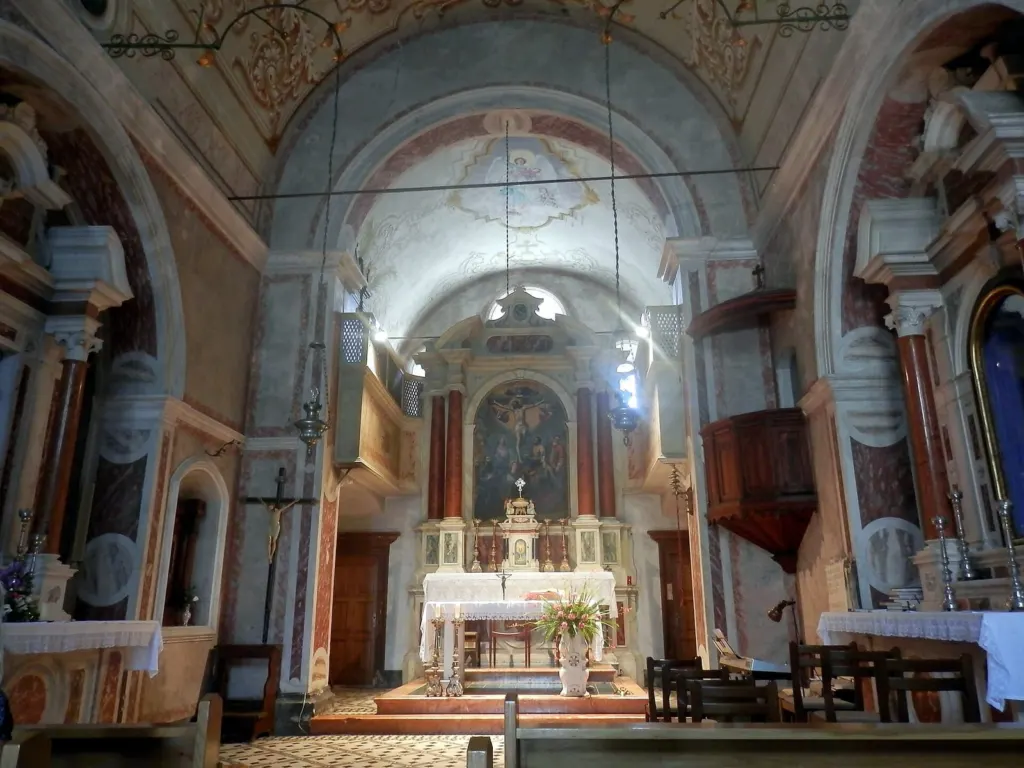
The church has a single nave, the main space for the congregation, about 25 metres long. It is covered by a barrel vault, semicircular like a barrel cut in half, and there are four chapels at the sides. During the restoration from 1906 to 1908 the walls were painted to look as if they were clad in Carrara marble: the edges like red marble, the altar niches like green stone.
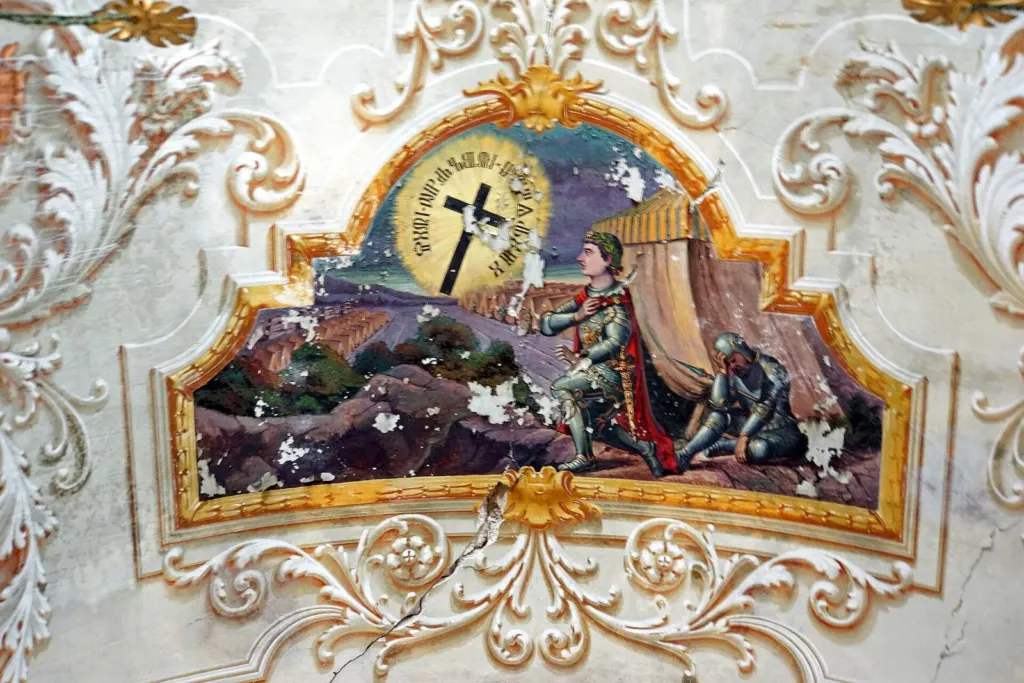
In the summer of 1907 the Split painter Francesco Ravalico painted the vault. Above the altar is Emperor Constantine the Great in front of a military camp. According to Christian tradition, Constantine saw the sign of the cross in the sky before a battle, so the painting suits a church of the Holy Cross well. Above the entrance Moses shows the people the tablets of God’s commandments, and in the corners of the vault are the symbols of the four evangelists.
The marble altar of Our Lady was made in 1766, and the wooden high altar holds a Baroque painting of the Holy Cross.
Altars, the library and the centuries up to the 1962 earthquake
The altar of St Paschal was rebuilt in stone in 1870. Behind the high altar is the sacristy, the room where services are prepared, and above it the choir, a gallery for the singers, with the organ. For two centuries young men and future friars were educated in the monastery, which is how its old library and archive came about. Several Baroque objects are also kept there.
As early as 1626 thirteen friars and eight young men studying there lived in the monastery, and in 1630 the Bishop of Makarska blessed its first bell. In 1628 the villagers of Živogošće granted the monastery common village land from which to take timber for building. This deed of gift is the oldest document in the monastery archive.
Under French rule the friars supported the uprising of the people of the Makarska coast. The French army drove them out in 1807 and occupied the monastery. In 1812 the furniture and church objects were sold at auction on the square in Makarska. That is also when the old monastery book with the details of its foundation was lost.
When Dalmatia passed to Austria, the monastery was returned to the Franciscans. They found it without floors or a roof, with collapsed walls and smashed doors and windows. The guardian, the head of the monastery, Fra Ivan Žderić, obtained new paintings, an organ and bells in 1824. In 1825 a marble plaque to Emperor Francis I was set into the sacristy wall in thanks for the return of the monastery.
In the Second World War Živogošće was an important port linking the island of Vis with the Makarska coast, and the monastery was badly damaged at that time. It was also seriously damaged by the 1962 earthquake and was thoroughly restored in the 1970s. The church of the Holy Cross is today the parish church of Živogošće.
Roman times
The Roman villa at Pločica in Mala Duba
The Romans were not only in Porat. At the site of Pločica in Mala Duba, in a fertile bay below the southern slopes of the hill of Suzina, archaeologists recorded the remains of a Roman country villa. A villa rustica is a Roman country estate: the owner’s house with farm buildings, surrounded by land that was farmed.
The remains were destroyed in the mid-1960s, when foundations for a house were being dug on the site. When the ground was dug for the neighbouring house, a continuation of the building and a fragment of a column could be seen, and an urn burial from the 1st or 2nd century is also mentioned near the villa. Scholars have linked the estate with the Licinianus inscription, about a kilometre to the west. Whether Licinianus owned this very villa or some estate closer to the spring in Porat is not known. For sightseeing, head for the monastery in Porat.
Even older: hillforts, burial mounds and the name of the village
People lived here long before the Romans. On the hills above the coast are hillforts (gradine), prehistoric settlements and strongholds enclosed by dry-stone walls, built of stones without mortar. The hillfort on Suzina, the hill above the monastery, was defended on its east side by a rampart about 60 metres long and about six metres wide. At the Matijaševica hillfort near Blato, according to the first finds, people lived from roughly the 8th to the 5th or 4th century BC.
On the slopes are burial mounds (gomile), stone mounds of the kind raised over graves in prehistory. The Croatian Encyclopaedia calls them Illyrian mounds. At the site of Markovina, also called Mijašine gomile, north of the hillfort on Matijaševica, the remains of fifteen such mounds have been recorded, some of them up to 15 metres across. Later building damaged some of the hillforts and mounds. On Suzina the damage was caused by the construction of a road, bunkers and trenches.
Živogošće is mentioned in written sources as early as between 1254 and 1264, together with the hamlet of Strnj. The linguist Domagoj Vidović derives the name from the old Croatian personal name Živogost, while Mala Duba appears in the sources in 1628. In the cemetery by the church of St Dominic (St Arnerius), beside the main coastal road in Živogošće, a slab carved with a sword and shield has survived, as has a stećak, a medieval chest-shaped stone tombstone, dating roughly from the 13th to the 15th century.
At the end of the 15th century the coast was conquered by the Ottomans, who held it for almost two centuries. In 17th-century Ottoman sources Živogošće is called Lužibaba, after lug, meaning a grove or wood. After the Ottomans, Venice ruled here until 1797, then the French from 1806 to 1813, and Austria until 1918.
How to visit
On foot to the inscription and the monastery
- To Porat along the sea. From Mala Duba, take the seaside promenade towards Igrane. Porat is about 1.2 km away, a walk of around twenty minutes.
- The inscription on the beach. Look for the large rock below the monastery. The letters are shallow and worn, so how clearly you can see them depends on the light. Look at the inscription, but do not touch it.
- The monastery and church. They stand above the beach, at Porat 137. The bell tower, the inscription above the church door and the monastery wings can be seen from outside. If you want to go into the church or ask about visiting the monastery, check the parish or monastery notices first. Mass is celebrated in the church, so enter quietly and dress appropriately.
- On to Igrane. If you’d like one more stop, carry on along the same promenade. In Igrane there is Zalina Tower, an old stone tower in the village, and the little church of St Michael from the 11th or 12th century, which is protected cultural heritage.
Where next
After your visit, have a swim at the beach below the monastery, or choose your next excursion in our guide.
Sources and official websites
- Register of Cultural Goods: the epigram in the rock (Z-4885) (in Croatian)
- Register of Cultural Goods: the monastery and church of the Holy Cross (Z-6605) (in Croatian)
- Register of Cultural Goods: St Michael’s church in Igrane (Z-4890) (in Croatian)
- Croatian Encyclopaedia: Živogošće (in Croatian)
- Epigraphic Database Heidelberg: Latin text of the inscription (HD053666)
- T. Maroević, Tusculum 10/2 (2017): review of the collection Carmina epigraphica (PDF, in Croatian)
- D. Ožić Bašić, Croatica Christiana periodica 61 (2008): building of the monastery in the 17th and 18th centuries (in Croatian)
- D. Ožić Bašić, Croatica Christiana periodica 63 (2009): restoration of the monastery in the 19th and 20th centuries (PDF, in Croatian)
- Franciscan Province of the Most Holy Redeemer: Živogošće monastery (in Croatian)
- Croatian Archaeological Yearbook 2/2005: Živogošće, Makarska City Museum (PDF, in Croatian)
- D. Vidović, Folia onomastica Croatica 21 (2012), pp. 208 and 211: the name Živogošće (PDF, in Croatian)
Photo credits
Photos from Wikimedia Commons: Porat – Holy Cross monastery – Ing.Mgr.Jozef Kotulič, CC BY-SA 3.0, source, resized · Porat – inscription in the rock below the monastery – Ministry of Culture and Media of the Republic of Croatia (author unknown), CC BY-SA 3.0 HR, source, resized · Porat – interior of the Holy Cross church – Ing.Mgr.Jozef Kotulič, CC BY-SA 3.0, source, resized · Porat – painting on the vault of the Holy Cross church – Dennis G. Jarvis, CC BY-SA 2.0, source, resized.


Our apartments
Three apartments, each with its own terrace. The beach is about a three-minute walk from the apartments.